Unveiling the Two Puzzles of Immersive Audio: Architectural Differences Between In-Car and Home Systems, and OpenAudio's Response
Unveiling the Two Puzzles of Immersive Audio: Architectural Differences Between In-Car and Home Systems, and OpenAudio’s Response
With the growing adoption of immersive audio technologies like Dolby Atmos and HoloSound, our listening experience is transitioning from planar to three-dimensional. However, when we look at the two major application scenarios—home theater and smart vehicles—we find two very interesting, even “strange,” technical differences in their architectures.
OpenAudio addresses these exact differences by introducing the AVR-1046 and AVR-1046-Car series, precisely tailored to meet the core requirements of each scenario.
Puzzle One: Multi-Format Compatibility vs. Single Technology Lock-in
Home Scenario Tendency: Home theater users prefer systems that support multiple immersive audio formats, such as ATMOS, DTS:X, and Auro-3D.
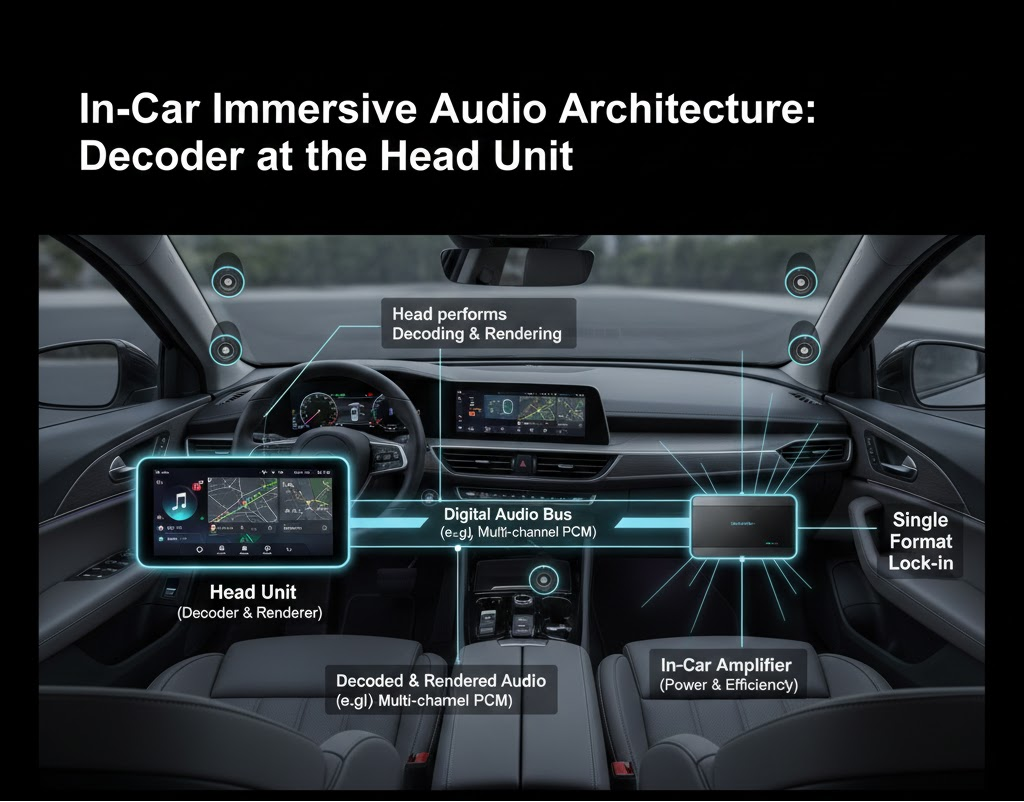
In-Car Scenario Tendency: Vehicle manufacturers (OEMs) tend to select and lock into a single immersive audio technology (e.g., ATMOS or HOLOSOUND) for a specific vehicle model.
💡 The Reasons Behind the Difference:
- Consumer vs. OEM Driven:Home users are enthusiasts who demand compatibility and flexibility to play content from any source. Therefore, AVR manufacturers must support all major formats. In contrast, in-car audio systems are driven by OEM design, budget, and integration goals. Choosing a single technology simplifies the certification process, reduces software and hardware costs, and ensures a consistent brand sound experience.
- Cost and Space Constraints:The in-car environment has strict limitations on cost and component size. Paying additional licensing fees and consuming chipset space for multi-format compatibility is often deemed impractical in automotive design.
Puzzle Two: The Decoding Location Shift
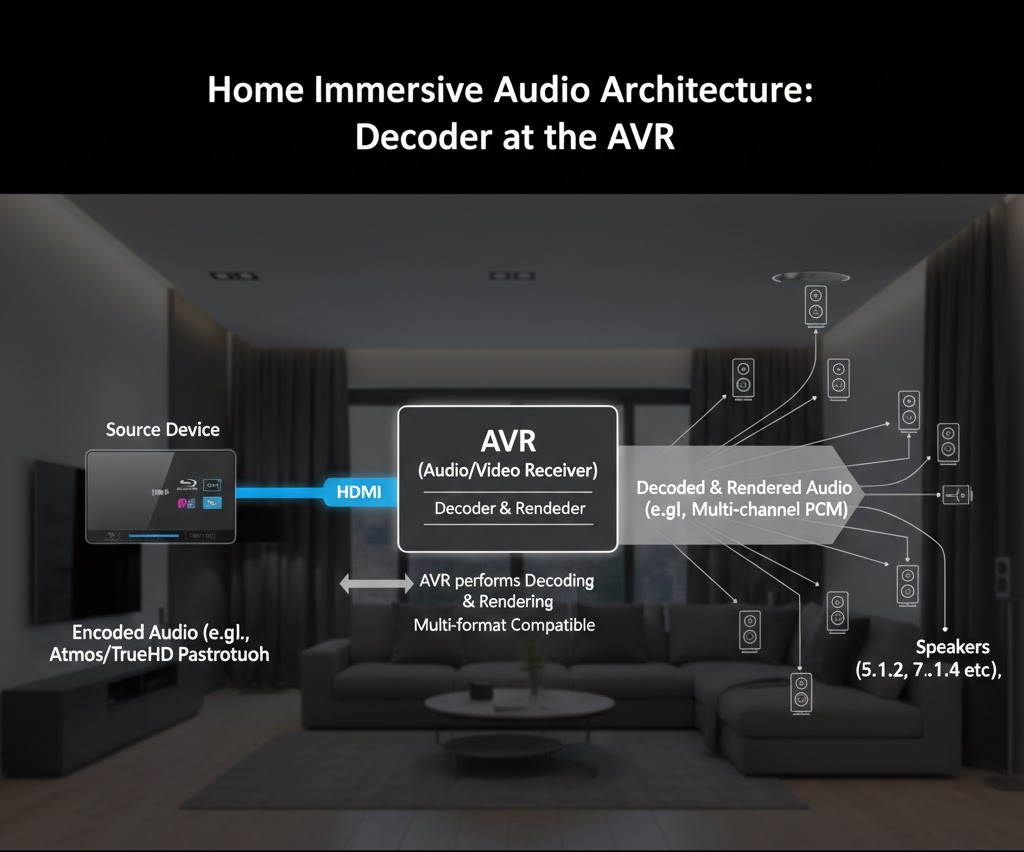
This is the most fundamental difference between the two architectures, determining the entire signal chain design:
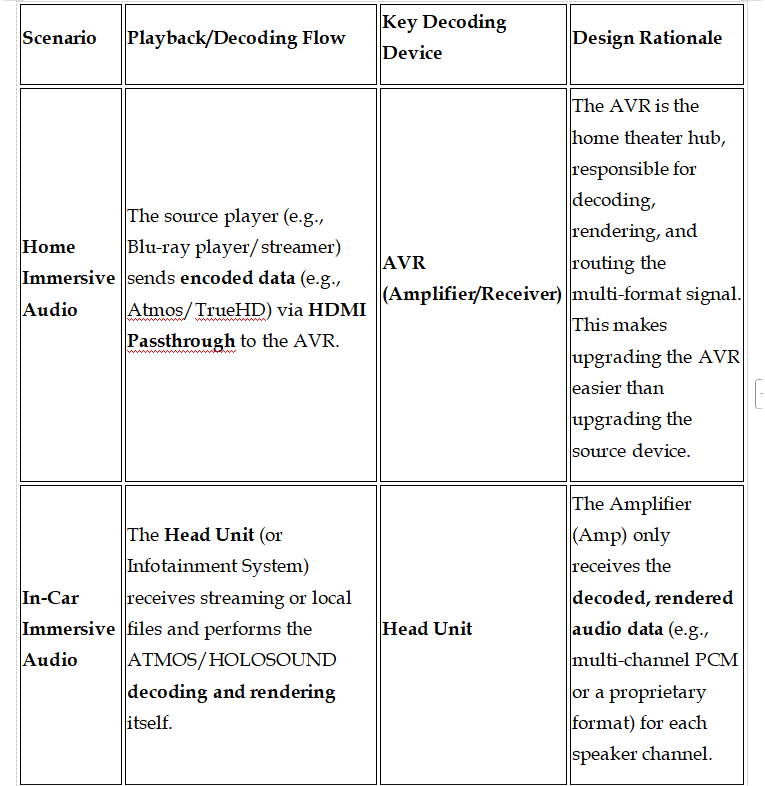
💡 The Reasons Behind the Shift:
- Data Reliability and Complexity:In the automotive environment, transmission between the Head Unit and the amplifier requires extreme stability and interference immunity. Transmitting high-bandwidth encoded formats (like TrueHD) places a high demand on the digital bus. By having the Head Unit perform the decoding/rendering, the resulting low-latency, multi-channel digital audio passed to the amp simplifies the amplifier’s complexity and enhances transmission reliability.
- Amplifier Size and Heat:Automotive amplifiers are typically installed in space-constrained areas with poor heat dissipation (like under a seat or in the trunk). Delegating the most complex computations (decoding and rendering) to the Head Unit, which usually has more robust computing power and better cooling, drastically reduces the amplifier’s size and cost, allowing it to focus solely on efficient, stable amplification.
The OpenAudio Dual-Architecture Strategy
OpenAudio recognized the fundamental differences in these two architectural demands and developed two customized products to achieve optimal matching in each scenario:
- The Home Core: OpenAudio AVR-1046 (Home)
- Role:The “brain” and central hub of the audio system.
- Design Philosophy:Ultimate compatibility and passthrough capability.
- Features:The AVR-1046 focuses on receiving multi-format encoded data streams (ATMOS/DTS:X/HoloSound) via HDMI and features premium decoding chips and rendering algorithms, perfectly fulfilling the role of the sole decoding center in a home theater setup.
- The Automotive Custom: OpenAudio AVR-1046-Car
- Role:An efficient, high-fidelity multi-channel amplification endpoint.
- Design Philosophy:Pure amplification, optimized for automotive digital reception.
- Features:The AVR-1046-Car eliminates complex immersive decoding modules. It is engineered to receive the already-rendered digital signal from the Head Unit. Featuring high-efficiency, low-heat automotive-grade power and amplification circuits, it drives every speaker in the vehicle with minimal loss and maximum stability.
Through this “dual-architecture” strategy, OpenAudio not only meets market demand but also technologically resolves the two “strange” architectural puzzles of in-car and home immersive audio, delivering an optimized listening experience for both environments.