HomeKit, Google Home, and Alexa: Choosing the Right Smart Home Audio Ecosystem
As smart homes become more intelligent, choosing the right smart home ecosystem is just as important as selecting the right hardware. For multi-room audio systems, ecosystem compatibility directly affects usability, scalability, and long-term flexibility.
Today, three platforms dominate the global smart home landscape: Apple HomeKit, Google Home, and Amazon Alexa.
Each ecosystem offers a distinct philosophy for voice control, automation, and device integration—especially when it comes to whole-home audio.
Why Ecosystem Choice Matters for Multi-Room Audio
Unlike single smart speakers, multi-room audio systems introduce additional complexity:
- Multiple zones playing independently or in sync
- Integration with lighting, displays, and automation scenes
- Voice control shared across rooms and users
- Long-term expansion as the home evolves
The ecosystem you choose determines how naturally these elements work together—and how future-proof your system will be.
Apple HomeKit: Privacy-First and Deep Apple Integration
Apple HomeKit is designed around simplicity, security, and privacy. It integrates seamlessly with iOS, iPadOS, watchOS, and macOS, making it a natural choice for Apple-centric households.
Strengths
- Strong emphasis on privacy and local control
- Tight integration with iPhone, iPad, Apple Watch, and HomePod
- Reliable automation scenes and Home app experience
- Clean, consistent user interface
Considerations
- Smaller third-party device ecosystem compared to Alexa
- Voice interaction is more structured
- Best experience requires Apple devices
For multi-room audio, HomeKit excels in stable, secure control, especially in premium residential environments where reliability matters more than experimentation.
Google Home: Intelligence and Context Awareness
Google Home is built on Google’s strengths in search, data, and AI. It offers strong contextual understanding, making voice interaction feel more conversational than traditional command-based systems.
Strengths
- Excellent natural language processing
- Strong voice recognition and contextual responses
- Seamless integration with Android devices
- Powerful automation routines
Considerations
- Privacy controls may require more user configuration
- User experience can vary across device brands
In multi-room audio scenarios, Google Home performs well when users expect flexible voice interaction and cross-device intelligence.
Amazon Alexa: The Most Open and Scalable Ecosystem
Amazon Alexa remains the most widely adopted smart home voice platform, particularly in North America and Europe. Its openness makes it highly attractive for large, complex installations.
Strengths
- Massive third-party device and skill ecosystem
- Flexible routines and multi-room voice grouping
- Wide range of compatible smart speakers and controllers
- Ideal for large homes and commercial environments
Considerations
- Voice commands can feel less natural without advanced AI layers
- Skill-based architecture may add complexity
For whole-home and commercial audio systems, Alexa’s strength lies in scale, compatibility, and flexibility.
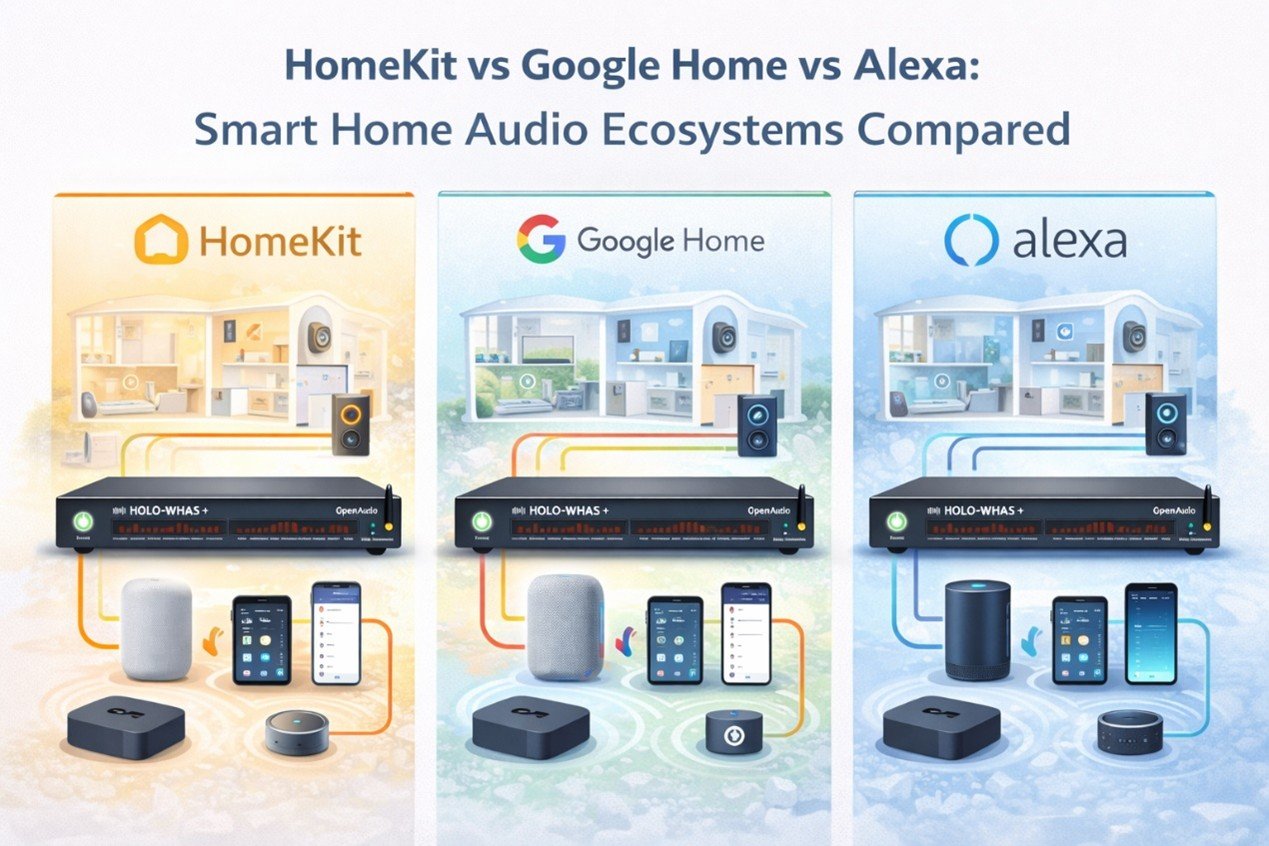
HomeKit vs Google Home vs Alexa: Smart Home Audio Comparison
|
Feature |
HomeKit |
Google Home |
Amazon Alexa |
|
Ecosystem openness |
Moderate |
High |
Very High |
|
Voice intelligence |
Structured |
Conversational |
Command + Skills |
|
Privacy focus |
Very High |
Medium |
Medium |
|
Multi-room scalability |
High |
High |
Excellent |
|
Best for |
Apple homes |
AI-driven homes |
Large / mixed systems |
There is no universal “best” platform—only the best fit for your environment, devices, and usage habits.
Why Modern Audio Systems Must Support All Three
As smart homes diversify, users increasingly expect audio systems to work across ecosystems, not be locked into one platform.
A future-ready multi-room amplifier should:
- Support HomeKit, Google Home, and Alexa simultaneously
- Allow users to change ecosystems without replacing hardware
- Offer consistent audio performance regardless of platform
- Serve both residential and professional installations
This approach protects long-term investment and simplifies system design for integrators and homeowners alike.
How Ecosystem Flexibility Shapes the Next Generation of Audio Systems
The smart home market is moving toward platform-agnostic hardware—devices that adapt to the user’s preferred ecosystem rather than forcing a choice upfront.
This trend is especially important for:
- Luxury residences with mixed device ecosystems
- Smart home upgrades over time
- Commercial and hospitality installations
- Global markets with different platform preferences
Multi-room audio systems that embrace ecosystem flexibility will define the next generation of smart home experiences.
Connecting Ecosystems to AI-Driven Multi-Room Amplifiers
The evolution of smart home ecosystems directly influences how voice control and automation are implemented in modern audio hardware.
A deeper look at how AI voice control and full ecosystem compatibility come together in next-generation multi-room amplifiers is explored in our main feature article:
👉 AI Voice Control for Multi-Room Amplifiers: What’s Coming in 2026
https://www.openaudiohome.com/ai-voice-control-multi-room-amplifier-2026
Conclusion: Choose Flexibility, Not Lock-In
Smart home ecosystems will continue to evolve—but hardware decisions last much longer. For multi-room audio, the smartest choice is not picking one ecosystem over another, but choosing systems designed to work with all of them.
Whether your home is built around Apple, Google, Amazon—or a mix of all three—ecosystem flexibility is the key to long-term smart audio success.