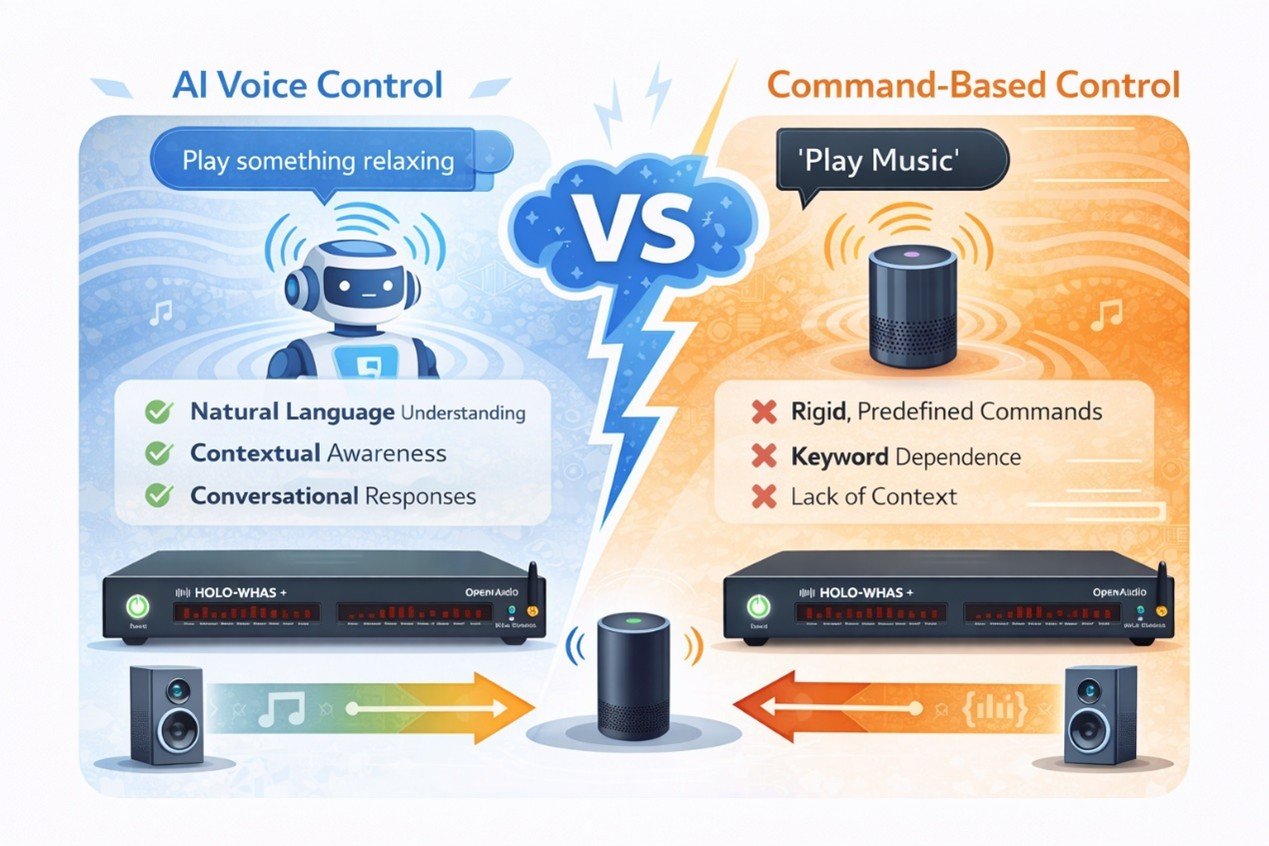
As voice control becomes a standard feature in modern smart homes, not all voice interactions are created equal. While many audio systems claim to support voice control, most still rely on command-based logic—a rigid system that limits how users interact with their smart home audio.
In contrast, AI voice control represents a fundamental shift. Instead of reacting to fixed commands, AI-driven systems understand intent, context, and natural language. This difference is especially critical for multi-room audio systems, where complexity increases with scale.
What Is Command-Based Voice Control?
Command-based voice control operates on predefined phrases. The system listens for exact keywords and executes a specific action only when the command matches its internal rules.
Examples include:
- “Play music”
- “Volume up”
- “Switch to HDMI input”
While functional, this approach has clear limitations:
- Users must memorize specific phrases
- Small wording changes often result in failure
- Commands lack contextual awareness
- Complex multi-room scenarios require multiple steps
For simple, single-device use cases, command-based control may be sufficient. However, as homes adopt multi-room audio, automation scenes, and cross-device synchronization, these limitations become increasingly obvious.
What Makes AI Voice Control Different?
AI voice control is built on natural language understanding (NLU) rather than keyword matching. The system interprets meaning instead of syntax.
With AI-driven voice interaction, users can speak naturally, without worrying about phrasing:
- “Play something relaxing for the evening.”
- “Lower the music in the bedrooms but keep the living room active.”
- “Switch to movie mode and make the sound more immersive.”
Instead of executing a single command, the system analyzes:
- User intent
- Room context
- Current playback state
- Historical usage patterns
This allows AI voice control to deliver responses that feel intuitive, adaptive, and human-like.
Why Natural Language Matters for Multi-Room Audio
Multi-room audio systems introduce complexity that command-based control struggles to handle.
A modern whole-home audio setup may include:
- Multiple zones and sub-zones
- Independent and synchronized playback
- Integration with lighting, displays, and automation scenes
- Different listening modes depending on time, activity, or occupancy
In such environments, saying “Volume up” is no longer enough. Users expect to express outcomes, not instructions.
Natural language enables:
- Fewer commands for complex actions
- Faster interaction across multiple rooms
- Reduced learning curve for family members and guests
- More reliable automation triggers
This is why AI voice control is quickly becoming a core requirement rather than a premium feature in smart home audio design.
Command-Based Control vs AI Voice Control: A Practical Comparison
|
Feature |
Command-Based Voice Control |
AI Voice Control |
|
Phrase flexibility |
Low |
High |
|
Context awareness |
None |
Advanced |
|
Multi-room handling |
Manual |
Intelligent |
|
Learning curve |
High |
Minimal |
|
Scalability |
Limited |
Excellent |
As this comparison shows, AI voice control is not just an upgrade—it is a different interaction model altogether.
The Future of Smart Home Audio Interaction
As smart homes continue to evolve, audio systems are transitioning from standalone devices into central interaction hubs. Voice is becoming the most natural interface, but only when it works the way humans communicate.
AI voice control enables:
- Conversational interaction
- Adaptive responses
- Seamless integration with automation logic
- Long-term scalability as homes grow
This shift is driving manufacturers to rethink how voice control is implemented at the platform level, especially for multi-room amplifiers and whole-home audio systems.
How This Evolution Connects to Next-Generation Multi-Room Amplifiers
The move from command-based control to AI-driven conversation is not theoretical—it is already shaping the next generation of smart home audio platforms.
A detailed look at how AI voice control is being integrated into modern multi-room amplifiers, along with ecosystem compatibility and real-world use cases, is covered in our main feature article:
Conclusion: Voice Control Should Feel Natural
Voice control should not require training, manuals, or memorized commands. As smart home audio systems grow more powerful, their interfaces must become simpler—not more complex.
AI voice control delivers what command-based systems cannot: natural interaction, contextual understanding, and effortless control across the entire home.
For multi-room audio, this shift is not optional.
It is the future.